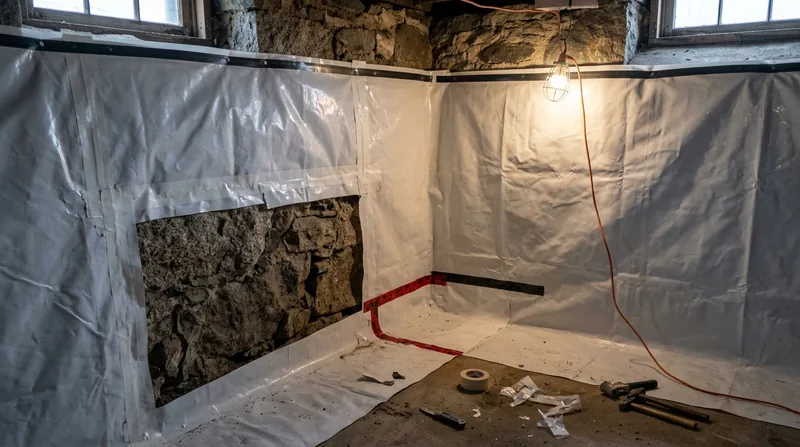




Vapor Barrier Installation in Portland: Seal Out Ground Moisture at the Source
Portland sits on a thick layer of Presumpscot marine clay, a fine gray silt left behind when the sea covered this area after the glaciers retreated. That clay holds water like a sponge, and in the 1880s to 1920s wood-frame and brick houses on Munjoy Hill, Parkside, the West End and Deering Highlands, moisture rises slowly through granite, fieldstone and early brick foundations every spring. Vapor Barrier Installation in Portland puts a heavy-duty barrier between that damp ground and your lower level, sealing the walls and slab so water vapor stops migrating into the rooms you actually use. We install sealed, taped and terminated barrier systems built for Maine's freeze-thaw cycles, not thin plastic that tears the first season. If you already see efflorescence or smell that musty basement odor, start with a free basement inspection so we can pinpoint where the vapor is entering.
Why Portland's Glacial Clay Makes Vapor Barriers Essential
Water moves slowly through Presumpscot clay, so it does not drain away after a nor'easter or the spring snowmelt. Instead it sits against the foundation, pushes through mortar joints and open cracks under hydrostatic pressure, and evaporates into the basement as vapor. In 1930s to 1960s Cape Cods and ranches in Bayside, Riverton and Westbrook, that vapor condenses on cool block walls and feeds the damp conditions where mold growth starts. Newer poured full basements in the Gorham and Windham subdivisions are not immune either: the clay still traps water against the wall, and the cool gray light off Casco Bay keeps surfaces cold enough to condense moisture year round.
- We block vapor at the wall and slab so the basement stays dry between rain events.
- We seal seams and terminations so humid air cannot slip behind the barrier.
- We integrate the barrier with your sump basin so collected water has a path out.
- We keep the system compatible with any drain tile already in place.
A properly sealed barrier turns a damp, unusable lower level into dry, stable space you can finish and use.
Key info: On a 1912 West End house with a fieldstone foundation, we found efflorescence halfway up the wall and a slab that stayed damp all summer. The barrier went in over a parged surface with taped seams and a sump connection, and the basement dried out within two weeks.
For official guidance on basement moisture and building science, the U.S. Department of Energy moisture control resource is a solid reference.
How We Install Vapor Barriers in Portland Basements
Every installation starts with a walkthrough of the foundation, slab and drainage. We check for active seepage, test the sump pump, and confirm whether water is coming through the wall or rising through the slab. From there we build the barrier system around what your basement actually needs, not a one-size-fits-all kit.
- We inspect the walls, slab and footing drain and note any cracks or bowing that need attention first.
- We clean and prep the surface, removing loose parging and efflorescence so the barrier bonds flat.
- We install heavy-duty barrier sheets across the walls and slab, overlapping and sealing every seam with tape.
- We terminate the barrier at the sump basin and integrate it with the interior perimeter drain where one exists.
- We test the system, check the discharge line and check valve, and walk you through what we did.
If the inspection turns up a failing drain tile or a sump that cannot keep up, we tell you before we seal anything.
Key info: In a 1958 ranch in Riverton, the sump pump ran constantly after every storm. We installed the barrier, tied it into a new sump pump installation, and the basement stayed dry through the next spring thaw.
Vapor Barrier Approaches We Use
The right approach depends on your foundation type, how much water is present, and whether you plan to finish the space. Here is how the main options compare.
| Approach | Description | Best for |
|---|---|---|
| Wall and slab barrier | Heavy-duty sheets run up the walls and across the floor, seams taped and terminations sealed. | Damp block or poured basements with vapor but no standing water. |
| Barrier with dimple board | Dimple board creates a drainage gap behind the barrier so water sheds to the perimeter drain. | Wet walls with active seepage and an existing interior drain. |
| Barrier with sump integration | Barrier ties into the sump basin so collected water exits through the discharge line. | Basements with a sump pump or where one is being added. |
| Sealed membrane on old stone | Parging plus a sealed membrane over uneven granite or fieldstone walls. | 1880s to 1920s foundations on Munjoy Hill and the West End. |
We match the approach to the foundation and the water, and we explain the tradeoffs before any work starts.
Vapor Barrier Installation Cost in Portland: What to Expect
Most vapor barrier work in Portland starts around From $3/sq ft, but the final number depends on the square footage, the foundation type and how much prep the walls need. A poured wall in a 2005 Gorham subdivision is faster to prep than a parged fieldstone wall in Deering Highlands, and that difference shows up in the price. Adding dimple board, tying into a sump, or repairing cracks first all move the figure. Get two or three estimates and compare scope, not just the bottom line. Our full pricing overview breaks down the variables so you can read each quote accurately.
Choosing a Waterproofing Contractor Near Me in Portland
Hiring for vapor barrier work near Portland means asking the same questions you would for any foundation job. Confirm the contractor is licensed and insured, ask for references from basements similar to yours, and get the scope in writing. If the work involves altering drainage or the sump discharge connection, check with the local building department, since rules vary by jurisdiction. Permits are commonly required for structural foundation repair and for work that changes drainage or the sanitary connection, and your contractor should know the local requirements.
- Ask for a certificate of insurance before work begins.
- Get at least two or three written estimates with the same scope.
- Ask for references from Portland-area basements with your foundation type.
- Confirm who pulls any required permit with the local building department.
When you are ready to talk through your basement, contact us for a free estimate and we will schedule a walkthrough.
Vapor Barrier Installation in Portland: Pricing Guide
| Service | Price | Details |
|---|---|---|
| Wall and slab barrier | From $3/sq ft | Includes surface prep, heavy-duty sheets, taped seams and sealed terminations across walls and floor. |
| Barrier with dimple board | From $4.50/sq ft | Adds drainage gap behind the barrier for active seepage, priced by wall area and drain condition. |
| Barrier with sump integration | On estimate | Ties the barrier into the sump basin and discharge line; scope depends on pump and piping condition. |
| Old stone foundation prep | On estimate | Parging and leveling uneven granite or fieldstone walls before the membrane goes on. |
| Travel | Included | In Portland and surrounding areas, no separate call-out or mileage fee. |
| Estimate | Free | Response within 24h at (207) 517-2867, no obligation to book. |
Indicative pricing, the exact cost depends on square footage, finish, and site access. Free personalized estimate within 24h at (207) 517-2867.


