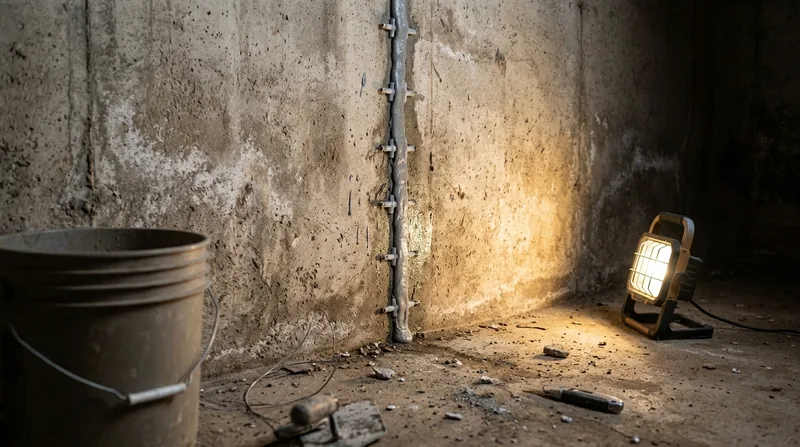




Foundation Crack Repair in Portland: Fix the Crack Before the Spring Clay Finds It
If you need Foundation Crack Repair in Portland, you are usually standing in a basement looking at a wet line on a granite block wall or a hairline in a poured wall that was dry last October. Portland sits on Presumpscot marine clay, a fine gray silt left when the sea covered this ground after the glaciers, and that clay drains slowly. Water stacks up against the foundation all spring, finds every open joint and crack, and shows up inside as seepage, efflorescence, or a damp ring at the lowest corner. The housing stock makes it worse: 1880s to 1920s wood-frame and brick houses on Munjoy Hill, Parkside, the West End and Deering Highlands sit on granite, fieldstone or early brick foundations with mortar that has been wet and dry for a century. We inspect the crack, identify what is moving it, and match the repair to the cause instead of smearing a patch over it. Start with a free basement inspection if you are not sure whether the crack is the whole problem.
Why Cracks Open in Portland's Glacial Clay and Granite Foundations
Most cracks we see in Portland are not random. The ground here is heavy clay sitting over ledge on the hills, so water moves slowly and rises through the wall each spring rather than running away. Snowmelt, nor'easter rain and freeze-thaw cycles push water into joints and open cracks in old stone, and the cool gray light off Casco Bay keeps those walls damp long after the rain stops. In the 1930s to 1960s Cape Cods and ranches in Bayside, Riverton and Westbrook, block walls crack at the mortar joints and along the block face. In the 1990s to 2020s poured full basements in the Gorham and Windham subdivisions, we see shrinkage cracks and frost-driven vertical cracks that open a little wider every winter.
- Hydrostatic pressure from saturated glacial clay pushes water through hairline cracks that look harmless in August.
- Freeze-thaw cycles widen existing cracks each winter as water freezes inside the wall.
- Old granite and fieldstone foundations leak at the mortar joints, not just at visible cracks.
- Block walls in mid-century homes crack at the mortar bed and along the block face.
- Poured walls in newer subdivisions develop vertical shrinkage and frost cracks.
- Efflorescence and a white salt bloom on the wall tell you water is moving through the masonry.
Any of those signs means the crack is active, and the repair should be chosen for the movement you actually have, not for the size of the stain.
Key info: A West End brick foundation with a stepped crack at the corner usually needs different treatment than a clean vertical crack in a 2005 Gorham poured wall. Same symptom, different fix, and the difference shows up in the first ten minutes of the inspection.
For the state's consumer guidance on hiring contractors, see the Maine Office of Professional and Occupational Regulation.
How We Repair a Foundation Crack in Portland, Step by Step
We do not sell one method to every homeowner. A non-structural crack gets injected and sealed; a crack that is moving because frost and wet clay are pushing the wall gets a structural answer. The inspection decides which, and we tell you plainly when simple crack sealing is enough and when the real problem is hydrostatic pressure that will keep finding new cracks. If the wall is bowing, the crack is a symptom and the wall needs bowing wall repair with carbon fiber straps or wall anchors.
- We walk the basement and the outside grade, map every crack, and check for efflorescence, rust stains and moisture readings.
- We identify the crack type: vertical shrinkage, diagonal settlement, stepped mortar joint, or horizontal movement.
- We clean the crack and set injection ports at the correct spacing for the width and depth.
- We inject epoxy for structural, cured cracks and polyurethane for active leaks and wet cracks that need flexibility.
- We seal the surface, verify the injection reached the full depth, and check the exterior grade and downspout extensions.
- We tell you if the crack is a drainage symptom and recommend an interior drain tile system or exterior work instead of repeated patching.
That last step matters most. A crack that leaks every spring because the clay cannot drain will keep leaking until the water is managed.
Key info: On a 1920s Deering Highlands house, we injected three vertical cracks in the fieldstone and found the real source was a downspout dumping at the corner and grade sloping back to the wall. The injection stopped the leaks; extending the downspout and regrading stopped the water from finding new ones.
Crack Repair Methods We Use in Portland
The table below shows the methods we actually use on Portland foundations and what each one is good for. We pick from it after the inspection, not before.
| Approach | Description | Best for |
|---|---|---|
| Epoxy injection | Ports set along the crack, epoxy injected under pressure to bond the crack faces | Cured, non-structural vertical and diagonal cracks in poured walls |
| Polyurethane injection | Flexible foam resin injected into wet or active cracks, expands and seals | Active leaks, wet cracks, cracks that move with frost |
| Mortar and parging repair | Rake out failed mortar, repack joints, parge the wall face | Granite and fieldstone foundations with deteriorating joints |
| Carbon fiber straps | Straps bonded to the wall to resist inward movement | Bowing block walls with horizontal or stair-step cracking |
| Wall anchors | Anchors driven into stable soil and tied to the wall to pull it back | Walls that have moved and need realignment, not just sealing |
If the inspection shows the crack is only the exit point for water under the footing, the right answer is drainage, and we say so before you spend money on injection that will not hold.
Foundation Crack Repair Cost in Portland: What to Expect
Foundation crack repair in Portland starts at $450 for a single non-structural crack, injected and sealed with the exterior cause checked. That figure is real for a clean vertical crack in a Gorham or Windham poured wall. It moves up when the crack is wide, when it is in old fieldstone with failed mortar, when there are multiple cracks, or when the wall is bowing and needs straps or anchors. Access matters too: a Munjoy Hill basement with a narrow bulkhead entry takes longer than a walkout in Falmouth.
We give you a written scope with the method named, the number of ports, and what we found outside. Get two or three estimates and compare the method, not just the number, because a $300 patch on a crack that needs injection is not a cheaper repair, it is a repeat visit. Our full pricing overview shows how the line items break down.
Key info: A South Portland homeowner got three quotes for a leaking block wall crack: two proposed a surface patch, one proposed injection plus downspout correction. The patch quotes were lower and both would have failed by the next March thaw.
Finding Foundation Crack Repair Near Me in Portland: What to Check Before You Hire
You want a contractor who will tell you what the crack is doing, not one who sells the same injection to every house. Ask for license and insurance certificates, ask how they decide between epoxy and polyurethane, and ask what they do if the crack is a drainage symptom. Structural foundation repair and work that alters drainage or the sump discharge connection commonly require permits in Maine, and the rules vary by jurisdiction, so confirm with the local building department before work starts. A contractor who hesitates on that question is telling you something.
- Confirm the company is licensed and insured, and ask for the certificate before work begins.
- Get two or three written estimates that name the repair method and the cause they identified.
- Ask for references from jobs in your part of Portland, not just anywhere in the county.
- Check who pulls the permit if the work is structural or alters drainage, and verify the requirement with the local building department.
- Ask whether the crack repair carries a transferable warranty and get the terms in writing.
If the answers are vague, keep calling. Contact us for a free inspection and a straight answer on whether your crack needs injection, structural repair, or drainage work first.
Foundation Crack Repair in Portland: Pricing Guide
| Service | Price | Details |
|---|---|---|
| Single non-structural crack injection | Starting at $450 | Epoxy or polyurethane injection with ports, surface seal, and exterior cause check included |
| Multiple cracks, same wall | Starting at $750 | Priced per crack after the first, with one mobilization and one inspection |
| Old granite or fieldstone joint repair | Starting at $1,200 | Rake out failed mortar, repack joints and parge; condition and access move the price |
| Structural repair (bowing wall) | On estimate | Carbon fiber straps or wall anchors need an on-site look at wall movement and soil |
| Travel | Included | in Portland and surrounding areas, no separate call-out or mileage fee |
| Estimate | Free | Response within 24h at (207) 517-2867, no obligation to book |
Indicative pricing, the exact cost depends on square footage, finish, and site access. Free personalized estimate within 24h at (207) 517-2867.


