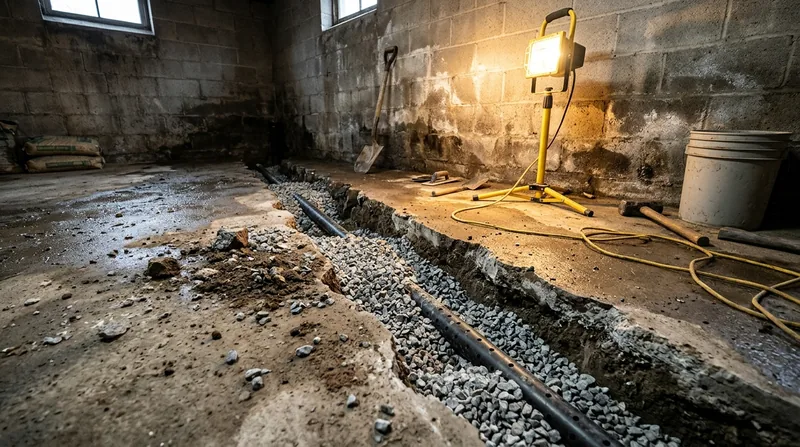




Interior Drain Tile System in Portland
Portland sits on a thick layer of Presumpscot marine clay, a fine gray silt left behind when the sea covered this ground after the glaciers. That clay holds spring meltwater and nor'easter rain like a sponge, and in the 1880s to 1920s wood-frame and brick houses on Munjoy Hill, Parkside, the West End and Deering Highlands, water rises through granite, fieldstone and early brick foundations and pools at the lowest corner of the cellar. An Interior Drain Tile System in Portland is the proven answer for that exact condition: we cut the slab edge, capture water at the footing, and channel it to a sump basin that pumps it out and away. It works on clay that never fully drains, and we can install it in any season, including a Maine winter. If you are weighing this against digging from the outside, start with our basement waterproofing overview and then compare.
Why Interior Drain Tile Matters in Portland's Glacial Clay
The failure mode that dominates here is hydrostatic pressure from slow-draining glacial clay soil sitting over ledge. On the hills, water percolates down until it hits rock, then rises through the walls and floor joints each spring. In the 1930s to 1960s Cape Cods and ranches in Bayside, Riverton and Westbrook, block walls wick that water and show efflorescence and damp lower courses. In the 1990s to 2020s poured full basements out in the Gorham and Windham subdivisions, the same clay pushes water through cold joints and form-tie holes. An interior perimeter drain intercepts water at the footing before it reaches the floor.
- We relieve hydrostatic pressure under the slab instead of fighting it at the wall face.
- We capture water at the footing where it actually collects, not just where it shows.
- We channel everything to a sump basin with a check valve and a discharge line that carries it away from the foundation.
- We keep the work below grade and inside, so frozen ground and snow do not stop the job.
That is why an interior system, not a coat of sealer, is the honest answer for a wet basement in this soil.
Key info: A Deering Highlands homeowner had water sheeting across the cellar floor every March for a decade. The stone footing was holding back clay that never drained. An interior perimeter drain and a new sump basin stopped it, and the floor stayed dry through the following spring melt.
For the code side, drainage and discharge work is regulated locally, so verify requirements with the City of Portland building department before work begins.
How We Install an Interior Drain Tile System in Portland
We start by finding where the water actually enters, because a wall seep and a floor seam call for different fixes. The crew lays out the perimeter, cuts a channel along the slab edge, and digs down to the footing. We set perforated drain tile in washed stone, protect it with filter fabric, and pipe it to a sump basin set at the low corner. Then we backfill, pour a neat concrete patch, and test the pump with real water before we leave.
- We inspect the basement and foundation and confirm the water source before quoting.
- We cut the slab edge and excavate to the footing around the interior perimeter.
- We set perforated drain tile in washed stone with filter fabric over it.
- We install the sump basin, pump, check valve and discharge line.
- We patch the slab and run a live water test on the finished system.
Every step is done with the basement in mind, including how the discharge line leaves the house.
Local example: In a 1920s West End house with a fieldstone footing, the lowest corner sat two inches below the rest of the slab. We set the sump basin there and tied the perimeter run to a battery backup, so a February power outage during a thaw would not leave the cellar full. See battery backup sump pumps for that setup.
Comparing Interior Drain Approaches for Portland Basements
Not every wet basement needs the same system. The right choice depends on your foundation type, how the water enters, and how much finish work sits on the floor. This table shows the approaches we use and where each one fits in Portland's housing stock.
| Approach | Description | Best for |
|---|---|---|
| Interior perimeter drain tile | Perforated tile set at the footing inside the slab edge, piped to a sump basin and pump. | Clay soil and rising water under the floor, any season. |
| Drain tile repair and replacement | We clear, re-line or replace failed existing tile and reconnect it to the sump. | Older homes with a clogged or collapsed footing drain. |
| Sump pump upgrade | A new pump, check valve and discharge line on an existing basin. | A working drain with a failed or undersized pump. |
| Exterior footing drain | Excavation outside the wall to intercept water before it reaches the foundation. | Open access and a wall that also needs exterior membrane work. |
We recommend the interior system most often in Portland because the clay holds water against the wall no matter what you do outside.
Interior Drain Tile System Cost in Portland: What to Expect
Most interior drain tile work in Portland starts around From $50/linear ft, and that figure reflects the clay, the old foundations and the slab cutting involved. A small basement in a Riverton ranch runs less than a full perimeter in a large Gorham poured basement. Access matters too: a finished basement with framing and flooring at the slab edge takes more care and time than a bare cellar. Getting two or three written estimates is smart, because a quote should explain what is included, not just give a number.
Cost moves with the linear footage, the foundation material (fieldstone and brick are slower to work than poured concrete), whether a sump basin and pump are new, and whether a discharge line needs a new path out of the house. We put the full breakdown on our pricing page so you can compare scope to scope. A free inspection tells you which of those factors actually apply to your basement before you commit.
Hiring an Interior Drain Tile Contractor Near Me in Portland
You want a specialist who works below grade every week, not a general handyman with a rented saw. Ask for proof of licensing and insurance, and get a certificate of insurance sent to you before work starts. Get two or three written estimates that list materials, linear footage and what happens to the slab afterward. Ask for local references from basements like yours, especially old stone or block walls.
Permits are commonly required for work that alters drainage or the sanitary connection of a sump discharge, and thresholds vary by jurisdiction, so confirm with the City of Portland building department. If your home sits in a historic district or an association, check those rules too. Our contact page is the place to set up a free inspection and get a written scope.
For a closer look at how the system fits a specific neighborhood, the Westbrook page covers the block-wall Capes and ranches on that side of the city.
Interior Drain Tile System in Portland: Pricing Guide
| Service | Price | Details |
|---|---|---|
| Interior perimeter drain tile | Starting at $50/linear ft | Includes slab cutting, perforated tile in washed stone, filter fabric and concrete patch. |
| Drain tile plus new sump basin and pump | Starting at $3,200 | Adds a new basin, pump, check valve and discharge line routed out of the house. |
| Drain tile repair or replacement | On estimate | Depends on how much existing tile is clogged, collapsed or wrongly pitched. |
| Finished basement with framing at slab edge | On estimate | Careful cutting and reinstatement around framing and flooring raises labor time. |
| Travel | Included | In Portland and surrounding areas, no separate call-out or mileage fee. |
| Estimate | Free | Response within 24h at (207) 517-2867, no obligation to book. |
Indicative pricing, the exact cost depends on square footage, finish, and site access. Free personalized estimate within 24h at (207) 517-2867.


