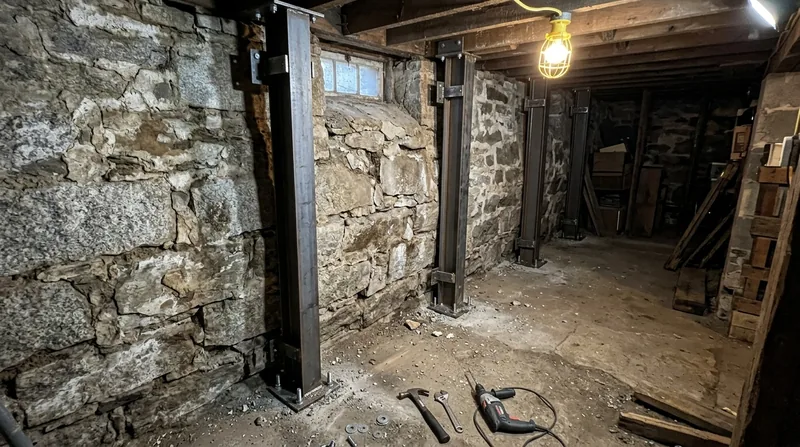




Bowing Wall Repair in Portland
When a foundation wall starts to lean or bulge, the cause is almost always outside the wall, not in it. In Portland, that means Presumpscot marine clay pushing against old granite, fieldstone, and early brick foundations on Munjoy Hill, Parkside, and the West End, where cellars were dug shallow and never drained. Bowing Wall Repair in Portland starts with reading the wall, the soil, and the water behind it before anyone touches a strap or an anchor. We stabilize the wall, relieve the pressure, and tell you plainly whether you are looking at simple crack sealing or a structural correction. Call (207) 517-2867 to set up a free basement inspection.
This page covers how we diagnose and correct a leaning or bowing wall in Portland and Cumberland County, what drives the cost, and how to choose a contractor who will not sell you an excavation you do not need. For the broader picture of water management around the foundation, see our basement waterproofing service.
Why Bowing Walls Are Common in Portland's Older Neighborhoods
Portland sits on ground left behind when the sea covered the area after the glaciers. That fine gray silt, Presumpscot marine clay, drains slowly and swells each spring as snowmelt and nor'easter rain soak in. On the hills it sits over ledge, so water has nowhere to go but sideways into the foundation. A stone or brick wall built in 1900 was never designed for that kind of sustained hydrostatic pressure.
Freeze-thaw cycles finish the job. Water enters a joint or an open crack, freezes, expands, and widens the opening a little more each winter. After several hard winters, a wall that was plumb when you bought the house is leaning an inch or two at the top. The warning signs are usually visible from inside the basement:
- You can see a horizontal crack running along the middle of a block or poured wall, which is the classic sign of soil pressure pushing inward.
- The top of the wall has moved inward while the base stays put, so a straightedge held vertically shows a gap.
- White efflorescence or damp patches appear along the wall after rain, telling you water is moving through the masonry.
- Doors and windows on the floor above stick or rack out of square as the wall shifts.
- Diagonal stair-step cracks climb through a block wall or open along the mortar joints of a stone wall.
Any one of these deserves a look before the next spring thaw. Two or more together mean the wall is actively moving and should be stabilized.
Key info: A 1920s brick foundation on the West End that shows a horizontal crack at mid-height and a top that has leaned in is a pressure problem, not a crack problem. Sealing that crack without relieving the load behind it just hides the symptom for one more season.
Structural foundation repair in Portland generally requires a permit, and the rules are set by the local building department, which you should verify before work begins. The City of Portland publishes its permitting guidance at portlandmaine.gov.
How We Diagnose and Correct a Bowing Wall in Portland
We start inside the basement, not with a shovel. The first question is whether the wall is still moving or has settled into a stable lean, because that decides whether you need carbon fiber straps, steel I-beams, or wall anchors. We check the wall with a plumb line and a level, map the cracks, and look at the soil and drainage on the outside. Then we match the repair to the severity of the movement and the pressure of the wet clay behind it.
- We inspect the full wall, the floor joint, and the footing, and we note every crack and its direction.
- We check grading, downspout extensions, and window wells to see where water is entering the soil near the wall.
- We measure the deflection and decide between carbon fiber straps, steel I-beams, or wall anchors based on how far the wall has moved.
- We relieve the pressure with drainage where it is needed, often an interior perimeter drain tied to a sump basin, so the repair is not fighting water.
- We install the stabilization system, torque it to spec, and document the wall position so future movement can be measured.
The order matters. A strap on a wall that is still being pushed by saturated clay will only hold until the next wet spring.
Key info: A Cape Cod in Westbrook with a block wall that had bowed about an inch and a half was strapped with carbon fiber and given an interior perimeter drain. Two winters later the wall had not moved, and the floor stayed dry through the March melt. A 1900s fieldstone cellar in Gorham needed steel I-beams because the wall had moved too far for straps to be reliable.
If the movement is concentrated at a single crack, foundation crack repair with epoxy or polyurethane injection may be all you need. If the wall itself is leaning, it is a stabilization job. We tell you which one you are looking at before any work is quoted.
Bowing Wall Repair Methods Compared
There is no single right method for every wall. The choice depends on how far the wall has moved, whether it is stone, block, or poured concrete, and how much water is in the soil behind it. This table shows how we match the approach to the condition.
| Approach | Description | Best for |
|---|---|---|
| Carbon fiber straps | Straps bonded to the interior face of the wall and anchored top and bottom to stop further inward movement. | Block or poured walls with modest deflection, usually under two inches. |
| Steel I-beams | Vertical steel beams set against the wall and tied into the floor and joists to hold the wall in place. | Stone or block walls with larger movement or heavy clay pressure. |
| Wall anchors | Anchors driven into the soil outside and connected through the wall to pull it back toward plumb. | Walls that can be straightened, where exterior access is workable. |
| Drainage correction | Interior perimeter drain and sump to lower the water table and remove hydrostatic pressure at the wall. | Any bowing wall with active water, which is most of them in Portland. |
| Epoxy or polyurethane injection | Injection ports seal a single crack and stop water moving through it. | Cracks without significant wall movement. |
Most Portland jobs combine two of these, typically a stabilization method plus drainage, because the clay keeps pushing until the water is managed.
Bowing Wall Repair Cost in Portland: What to Expect
Pricing for this work starts at $600 for a focused repair such as crack injection or a small stabilization detail, and climbs from there. A full wall stabilization with carbon fiber straps typically runs well into the thousands, and a stone wall that needs steel I-beams and drainage lands higher still. The honest answer is that no two walls are the same, and a number given over the phone is a guess.
Several things move the price: how far the wall has deflected, whether it is stone, block, or poured concrete, how much excavation the anchor or drainage work requires, and whether the water problem needs an interior drain tile system or a sump pump replacement at the same time. Access matters too, and a tight West End basement is slower to work in than an open Gorham full basement. Get two or three written estimates and compare what is actually being installed, not just the bottom line. Our pricing page lays out the ranges in detail.
Bowing Wall Repair Near Me: How to Choose a Contractor Near Portland
You want a contractor who will tell you when a wall does not need structural work. That is the first test. A specialist should be able to explain why a crack is or is not a sign of movement, and should be willing to say that sealing is enough when it is. Ask for proof of licensing and insurance, and ask for references from jobs in Portland and the surrounding towns.
Get at least two estimates in writing, each with a clear scope of what is being installed and what is not. Ask who pulls the permit, since structural foundation repair usually requires one and the local building department sets the threshold. Ask what warranty comes with the work and whether it is transferable. A contractor who cannot answer those questions plainly is not the one you want holding your wall. Reach us through our contact page to schedule a free inspection.
Key info: We will also tell you when the right answer is a $600 crack repair instead of a full stabilization, because a wall that is not moving does not need to be strapped.
If you are seeing a lean, a bulge, or a horizontal crack in your foundation, do not wait for the spring melt to make it worse. Call Portland Waterproofing at (207) 517-2867 for a free basement inspection and a straight answer about what your wall needs.
Bowing Wall Repair in Portland: Pricing Guide
| Service | Price | Details |
|---|---|---|
| Crack injection (epoxy or polyurethane) | Starting at $600 | Seals a single non-moving crack; price rises with crack length and number of ports |
| Carbon fiber strap installation | Starting at $1,800 | Straps bonded to the wall and anchored top and bottom; price moves with wall length and access |
| Steel I-beam stabilization | Starting at $3,500 | Beams set against the wall and tied into floor and joists; stone walls and heavy clay push cost more |
| Wall anchor system | On estimate | Requires exterior access and soil assessment, so it needs an on-site look before a number is given |
| Travel | Included | In Portland and surrounding areas, no separate call-out or mileage fee |
| Estimate | Free | Response within 24h at (207) 517-2867, no obligation to book |
Indicative pricing, the exact cost depends on square footage, finish, and site access. Free personalized estimate within 24h at (207) 517-2867.


